Credit grows 12.7% as Indonesian banks eye AI projects
JAKARTA – PT Bank Danamon Indonesia Tbk (BDMN) believes investment in artificial intelligence (AI) is beginning to emerge as a driver of banking credit growth, particularly through financing for data centre development.
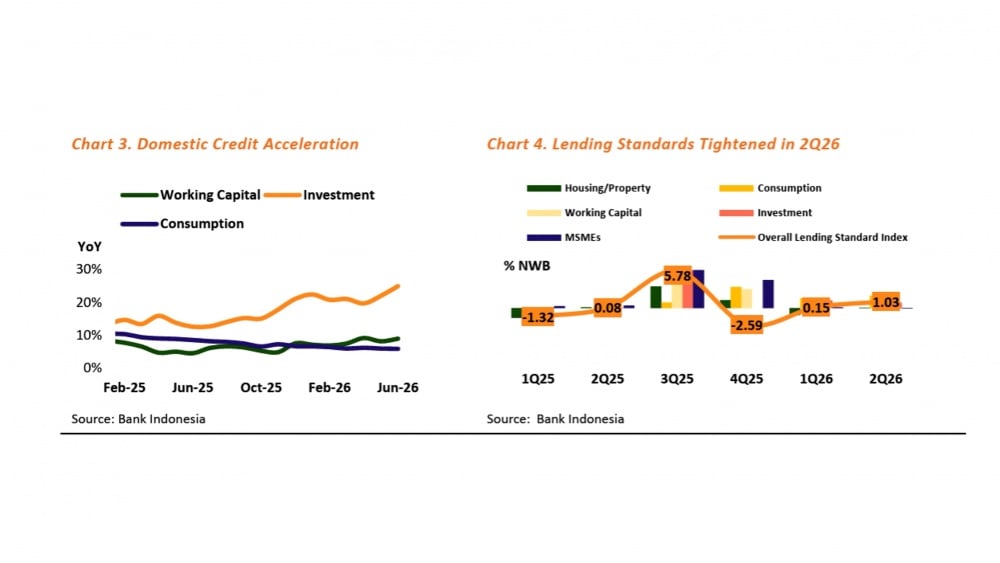
In its Indonesia Macro Glint report dated 29 July 2026, BDMN said bank lending grew 12.7% year on year in June 2026. The expansion was driven by investment loans, which surged 24.9% year on year, supported by financing for government priority projects and data centre infrastructure.
Working capital loans, meanwhile, rose 8.9% year on year, while consumer lending increased 5.8%.
Irman Faiz, BDMN's lead economist, said investment in AI and data centres is unlikely to have an immediate impact on household consumption because such projects are more capital-intensive than labour-intensive.
"The spillover effect on household consumption is unlikely to materialise immediately because these projects are relatively more capital-intensive than labour-intensive," Irman told IDNFinancials.com via WhatsApp on Thursday (30/7).
According to Irman, the short-term economic benefits of such investment are more likely to be felt during the construction phase and in supporting industries such as utilities, construction and professional services. However, any recovery in household purchasing power will continue to depend largely on job creation in labour-intensive sectors.
"Therefore, I believe the recovery in household purchasing power will continue to be determined primarily by employment growth in more labour-intensive sectors, higher real incomes and broader household consumption."
He said AI investment remains important because it enhances productivity and supports long-term economic growth. However, boosting consumption in the near term will require investment that is more closely linked to job creation.
Irman also cautioned that financing AI-related projects requires disciplined risk management, as the rapid pace of technological development could lead to overcapacity and technology obsolescence.
"These risks certainly need to be taken into account. However, I believe banks remain sufficiently prudent in extending financing to the AI and data centre sectors."
He said financing is generally directed towards projects that already have anchor tenants, long-term contracts, or backing from hyperscalers and companies with strong credit profiles. As a result, lending decisions are based not only on the technology's prospects but also on commercial viability and the project's ability to generate cash flow.
He added that banks also conduct stress tests on projected utilisation rates, demand and a project's ability to adapt to technological change before approving financing.
The risks of overcapacity and technology obsolescence remain, given the rapid evolution of AI. As such, banks typically stress-test utilisation forecasts, demand projections and the project's capacity to keep pace with technological advances.
As long as underwriting discipline is maintained and financing is focused on projects with strong fundamentals, Irman believes risks to banks' asset quality will remain relatively manageable.
"What must be avoided is overly aggressive lending simply to capitalise on the AI boom without considering the long-term sustainability of the business model," he said.
With demand for digital infrastructure continuing to rise to support AI development, BDMN believes data centre financing could become an increasingly important source of investment loan growth. Even so, the bank said such expansion must continue to be accompanied by prudent lending practices to safeguard asset quality. (DH/ZH)
